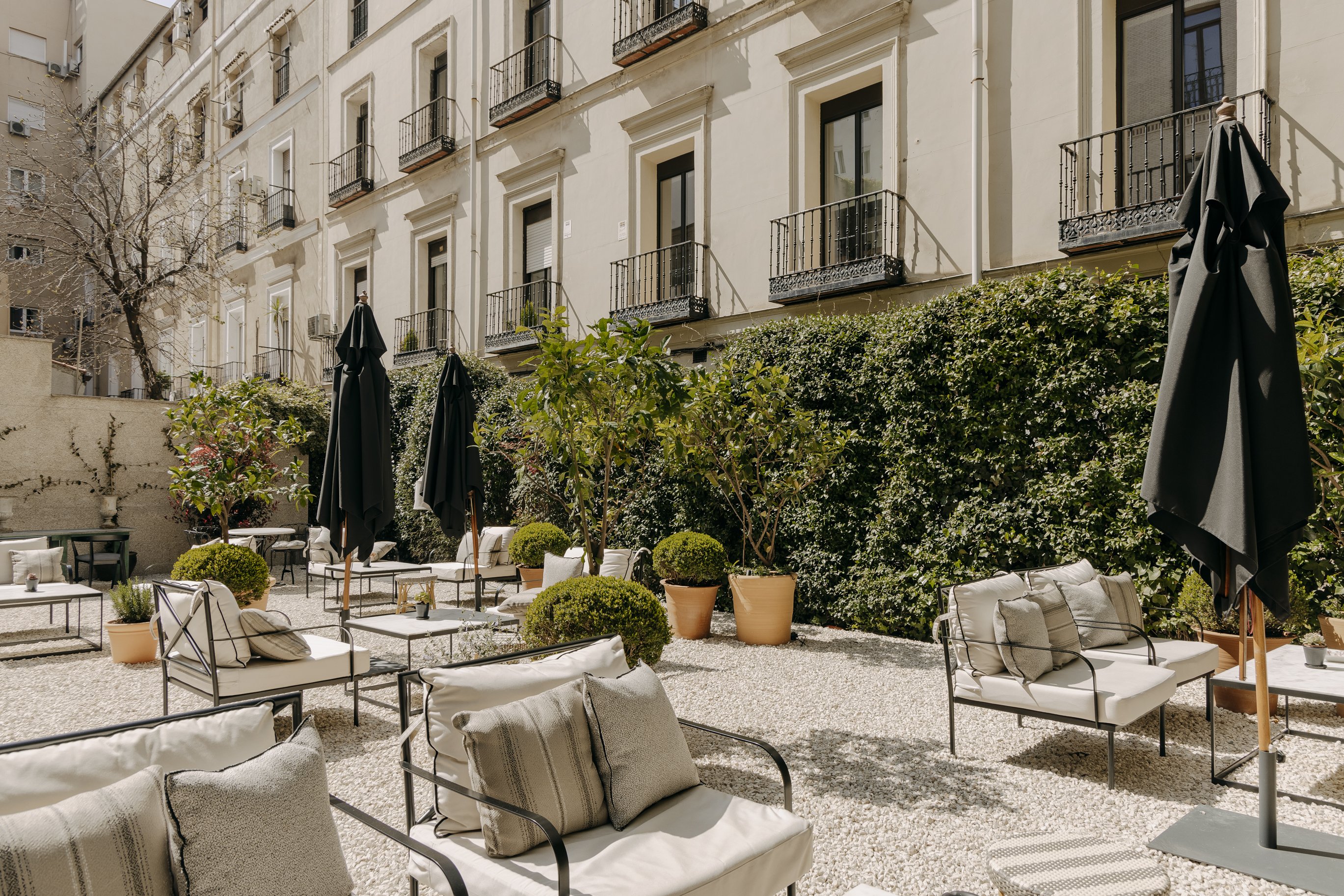
Madrid (Província)
Hotel Unico Madrid
R$3,877 / night

Destination
Explore the vibrant energy of Madrid! Discover the best attractions, from the Prado to Retiro Park. Plan your complete trip to Spain with must-know tips here.
Madri · Brasil
Photos
Discover the landscapes and culture of Madrid


Editorial guide with history, culture, and practical tips to plan your trip.
Madrid is more than just a city; it is a municipality and the beating heart of Spain. Strategically positioned in the geographical center of the country, it plays the vital role of capital for both the Spanish State and the Community of Madrid. Since its origins, established with the historical status of a town (villa), this location has consolidated itself as a hub of intense activity and national importance. Its demographic magnitude is one of the most notable facts: within its municipal limits, it holds the title of being the most populous municipality in Spain.
Examining the figures reveals the gigantic scale characterizing this metropolis. The resident population in the municipality reaches approximately 3.5 million inhabitants (specifically 3,506,730). This number not only affirms its status as the largest urban center in the country by municipal residents but also solidifies its position as a demographic giant in the European Union. When considering the entire metropolitan area—the vast urban fabric surrounding the central core—the figures rise even higher, reaching almost 6.8 million inhabitants (approximately 6,779,888). This population and administrative growth ensures that Madrid is not just a tourist destination, but a vital center of economic and social influence across the European continent.
Its central location within the Community of Madrid gives it undeniable geopolitical importance. It is here that the administrative and cultural structures are concentrated that define modern Spanish identity, making it a point of cultural convergence for various regions of the country.
Although the provided records do not detail specific historical chronologies, Madrid’s administrative status speaks volumes. Its history is intrinsically linked to its function as a center of power and administration in the heart of Spain. The location's historical classification as a 'villa' attests to deep urban and social development over the centuries, indicating that it was not merely a temporary settlement, but rather a fixed nucleus of civilization and commerce.
Its evolution into the capital of both the State and the Community of Madrid reflects a trajectory of increasing political importance. The centralized administration in this location ensured that social and economic development occurred on a large scale. This historical continuity is fundamental to understanding the city's current structure, where centuries of co-existence and population growth have molded a dense and vibrant urban environment.
The fact of being considered one of the most populous cities is not merely statistical; it carries the weight of a long history of attraction. Over time, Madrid has known how to reinvent itself and expand its urban core to accommodate millions of inhabitants who converged upon its centrality, consolidating a palpable historical legacy on every corner and in every architectural structure.
Madrid's culture is a direct reflection of its history and, most importantly, its colossal population size. Being the most inhabited core does not imply only numbers; it means a rich cultural tapestry where regional traditions meet and dialogue with European modernity. The capital serves as a breeding ground for artistic, literary, and gastronomic manifestations, fueled by the constant flow and diversity of its inhabitants.
Madrilenian culture is defined by its capacity to absorb. It welcomes the cosmopolitan lifestyle of the metropolitan area’s almost 6.8 million people while simultaneously preserving the identity and dignity of local and historical traditions. The population density contributes to an unmatched cultural vitality, where museums, theaters, and public spaces are constant stages for the meeting of high culture with daily life.
This constant mix of cultures—whether from the continuous arrival of people from various parts of Spain or the world, or due to its state centrality—creates a pulsating cultural atmosphere. It is a vibrant center where art is not confined to grand museums; it permeates the rhythm of the streets, the encounters in squares, and the warmth of traditional neighborhoods.
Geographically, Madrid occupies a privileged position in the heart of the Iberian Peninsula. Its central location is a determining factor that explained its historical growth and strategic importance to this day. This centrality is not merely symbolic; it positions the city at a nodal point for transport connections, commerce, and regional influence.
In terms of territorial and residential dimension, the contrast between the municipality and the metropolitan area is fundamental to understanding its urban geography. The municipal perimeter, which covers 3.5 million inhabitants, is in itself one of the largest and most densely populated in Spain, surpassing almost all other locations in the country by population. However, when considering its functional geographical reach—the so-called metropolitan area—we are talking about a massive region encompassing approximately 6.8 million people. This vast expanse is what allows Madrid to operate as a true European mega-urban center.
It is this confluence geography: being in the geographical center while simultaneously being one of the largest population clusters in the European Union, that defines its unique role in the Spanish landscape. The city has developed by utilizing the resources and connection routes provided by its central position.
The source material does not provide specific climate details for Madrid. However, the status of the city as a large European urban pole with moderate continental climate profoundly influences its rhythm of life and activities throughout the year. Large metropolises tend to create complex urban microclimates, where architecture and population density interact with general climatic patterns.
Generally, its position in the interior of the Iberian Peninsula means that the city is subject to seasonal variations typical of continental climate. The challenge for an urban center of this size is managing extreme temperature variations between seasons while maintaining vitality and services for millions of inhabitants under different environmental conditions.
Climate adaptation is part of the cultural routine: hotter months intensify socializing in squares under the shade and encourage open-air nightlife, while colder seasons maintain a rhythm of intense activity within monumental buildings. Climate is therefore a component that modulates the experience lived by the unique mass population that Madrid houses.
The factor of tourist attraction in Madrid derives directly from its uniqueness: being simultaneously the political and cultural center of Spain and a colossal urban cluster. The city, with its status as both the State and Community capital, necessarily concentrates the country's main points of historical, artistic, and gastronomic interest.
Its demographic magnitude is, in itself, a tourist attraction. The constant flow of new residents and visitors (feeding the metropolitan population of 6.8 million) ensures that the rhythm of the city is dynamic and multi-faceted. Tourists do not just come to see monuments; they come to experience a vibrant and complex urban lifestyle.
Madrid's ability to maintain its historical charm (as evidenced by its status as a town) while operating as a continental-scale metropolis is the great appeal. Whether it is the interest in cultural aspects from the past, or the modern experience of a high-density European center, the city offers unparalleled depth to the visitor. Its central role guarantees that it is an obligatory stop for anyone wishing to understand the heart of Spanish civilization.
The most notable and fascinating fact about Madrid is its population size, which places it in a unique statistical position within the European scenario. First, it should be noted that, within the municipal scope, it holds the title of Spain's most populous municipality. This statistic reflects the success of its urban and administrative growth.
Secondly, its classification as a demographic center makes it a giant in the European Union. With nearly 3.5 million inhabitants just in the core municipality, it has established itself as one of the two largest cities by population in the European bloc, surpassing countless historical and economic centers.
Furthermore, it is essential to differentiate between the municipality and the metropolitan area. The fact that the surrounding region registers about 6.8 million inhabitants shows that the concept of Madrid goes far beyond strict administrative limits; it is a gigantic urban ecosystem where life and activities radiate out over a vast central geographical area of the country.
This combination of being a fundamental political center (capital) with record population density gives it the status of a fascinating socioeconomic experiment for those who study large urban centers, making it a pole that attracts and concentrates millions of people in constant movement. It is this monumental scale that defines the Madrileño experience.
Everything you need to know to plan your trip
Reference figures to help plan your trip
Attractions
8
Selected stays available to book
148 travelers searched Madri this week
Stays for these dates are among the most sought-after in Madri
Madrid (Província)
R$3,877 / night

Madrid
R$5,525 / night

Madrid
R$2,586 / night

Madrid
R$4,180 / night

Madrid
R$1,869 / night

Madrid
R$2,172 / night

Madrid
R$3,736 / night

Madrid
R$3,841 / night

Madrid (Província)
R$3,259 / night

Madrid
R$3,063 / night

Madrid (Província)
R$2,758 / night

Madrid
R$2,401 / night
Must-sees, local secrets, experiences, and hotels — filter layers and tap the pins.
Everything you need to know to plan your trip
Get notified when hotel prices in Madrid drop. No spam.
We use your email only to send this price alert. Unsubscribe anytime.
Extend your trip to incredible destinations nearby
Still unsure? See side-by-side comparisons to decide.
We personalize every moment of your journey — from iconic landmarks to hidden cultural gems.
Available 24/7 · Personalized consultations · Local expertise
Updated on July 19, 2026 · Methodology · Authors
Sources
Testimonials
Stories from travelers who have already visited. Share your experience — your comment appears in the cards below.
Visiting Madrid exceeded all expectations. The energy of the place is contagious!
Wagner Lisboa
Traveler from Manaus
We traveled as a family and Madrid delighted kids and adults alike. Great hotel and attraction picks.
Arthur Klein
Tourist from Germany
I arrived without a fixed itinerary and Madrid surprised me at every corner. So welcoming.
Cíntia Rodrigues
Family with kids
Stayed near downtown and walked everywhere. Madrid is even better on foot.
Fabiano Lopes
Food lover


