
Fernando de Noronha
Pousada Maravilha Fernando de Noronha
R$986 / night

Destination
Discover Fernando de Noronha! Explore the paradisiacal beaches and unique biodiversity of this Pernambouco archipelago. Your dream destination in the Northeast.
Fernando de Noronha · PE · Brasil
Photos
Discover the landscapes and culture of Fernando de Noronha


Editorial guide with history, culture, and practical tips to plan your trip.
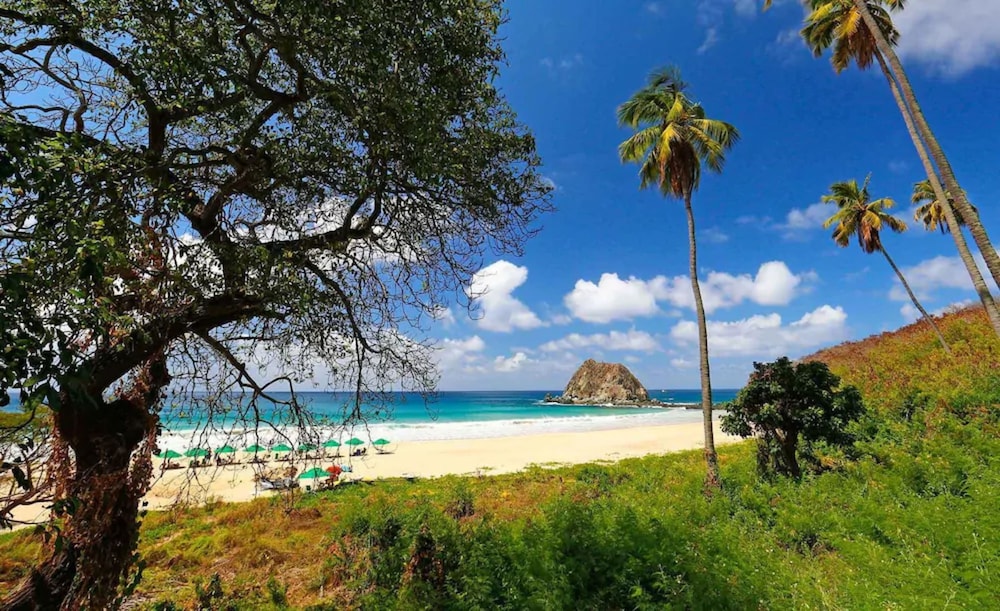
Fernando de Noronha is not just a destination; it is a natural jewel preserved by time and the waters of the Atlantic Ocean. This Brazilian archipelago, belonging to the state of Pernambuco, represents a paradisiacal refuge that captivates travelers with its untamed beauty and unique ecosystem. Its singular composition, formed by 21 islands, islets, and impressive rocks, tells a fascinating geological story: one of purely volcanic origins. The archipelago establishes itself as a focal point on Brazil's northeastern coast, recognized not only for its aesthetic beauty but also for its invaluable environmental worth.
In geographical terms, Fernando de Noronha is strategically positioned in the Atlantic Ocean, northeast of the Brazilian continent. This privileged location grants it majestic isolation, ensuring that its landscapes maintain a wild and untouched character. The total area occupied by this small natural treasure is remarkable: 26 square kilometers. Of this total, about 17 km² correspond to the main island, the core where daily activities and local commerce take place.
Urban life in Noronha is concentrated in the commercial center known as Vila dos Remédios. While this is the hub of human convergence, it is important to note that the National Park administration maintains a strict conservation guard, exercised by the Chico Mendes Institute for Biodiversity Conservation (ICMBio). This administrative control underscores the place's ecological importance and ensures that tourism development coexists harmoniously with the preservation of marine and terrestrial life. For visitors, Noronha is a destination where luxury meets nature in its purest form.
The history of Fernando de Noronha is intrinsically linked to its volcanic geography and its isolation in the Atlantic Ocean. While the details of the first human occupations are complex, what is undeniable is that this archipelago maintained its own rhythm, shaped by natural forces and the sea.
The geological profile of the location tells the saga of ancient volcanic eruptions, resulting in the 21 islands, islets, and rocks that compose it. This volcanic origin is not just a scientific fact; it defines the dramatic and spectacular character of the landscapes found there, with imposing cliffs and crystalline bays.
With the passage of time and increased regional strategic importance, Fernando de Noronha gradually became part of Brazil's economic and tourist landscape. Its relevance is such that it is classified as both an intermediate and immediate region relative to the capital of Pernambuco, Recife. This connection not only facilitates access but also culturally integrates the archipelago into the broader rhythm of the Northeast Region of Brazil, without ever losing its unique and protected identity.
The modern management of the park reflects a historical recognition of its value. The administration by ICMBio demonstrates that this place's history is told today primarily through science and conservation, ensuring that future generations can enjoy the integrity of this maritime and terrestrial ecosystem.
The culture of Fernando de Noronha is a fascinating mosaic, a direct result of its geographical isolation and its calling toward preservation. Although the permanent population remains relatively low (with data indicating a population around 2930 individuals), this small community has developed a life deeply intertwined with respect for the environment.
The lifestyle is governed by a slow pace and close coexistence with nature. Vila dos Remédios, being its commercial center, is where human interactions are concentrated, but these are always permeated by a striking ecological awareness. Residents live in harmony with the tide cycle and the challenges of being a settlement in such a fragile and beautiful environment.
The local culture celebrates maritime life and the biodiversity that thrives among the 21 islands and rocks. Traditions, while influenced by the rest of Pernambuco, possess their own flavor, mixing popular knowledge with a strong ethic of conservation. Local guides, for example, are not just tour conductors; they are guardians of the archipelago's natural history.
Therefore, tourism in Fernando de Noronha transcends the mere consumption of services; it becomes an immersive cultural experience in the serene and disciplined rhythm of a tropical paradise. It is a place where culture is synonymous with ecology, requiring visitors to adopt a more contemplative and responsible behavior.
From a geographical point of view, Fernando de Noronha is a masterpiece of nature—an archipelago located in the Atlantic Ocean. Its composition reveals a powerful and dramatic history: the entire structure, including the 21 smaller islands and rocks scattered across the surrounding sea, has a purely volcanic origin. This genesis gives the location a rugged and stunning relief.
The total area that defines this territory is 26 km². The distribution of this space is uneven, highlighting the main island, which covers 17 km²—the cradle of community and commerce. The other properties are smaller nuclei, but equally vital for maintaining the marine and coastal ecosystem.
The archipelago is in a prime geographic position in the Brazilian Northeast. Its coordinates place it at a considerable distance, attesting to its majestic isolation: it is located 350 km north of the state of Rio Grande do Norte and slightly further from the Pernambouco capital, Recife (approximately 545 km).
The administrative organization reflects this importance. Although it is an intermediate and immediate region relative to Recife, its management is strictly controlled by the National Park, administered by ICMBio. This overlap of jurisdictions ensures that human development (concentrated in Vila dos Remédios) does not compromise the geographical and biological integrity of its islands.
The climate in Fernando de Noronha is characteristic of the Northeast coastal region but with moderating influences due to its insular position in the Atlantic. The archipelago enjoys a tropical and maritime climate, which drastically softens the extreme temperature variations expected from the continent.
The constant presence of the Atlantic Ocean guarantees a gentle sea breeze for most of the year. This oceanic influence results in pleasant temperatures and high humidity. Rainfall tends to follow tropical patterns, but the regime is generally one of climatic stability, ideal for outdoor activities.
The beauty of the beaches and marine life are influenced by the Atlantic currents. The clarity of the water and the sea temperature, inviting divers year-round, are direct reflections of this powerful maritime climate. The ideal climate regime keeps the ecosystems vibrant, supporting rare marine and floral species.
In summary, Noronha’s climate is an essential element of the tourist experience: it is hot, humid, and incredibly conducive to aquatic life, ensuring that weather conditions are almost always favorable for contemplating the volcanic and beach landscapes.
Tourism in Fernando de Noronha is synonymous with luxury ecotourism and conservation. It is not just about visiting a beautiful location; it is about actively participating in the preservation of a natural sanctuary. The archipelago has attracted travelers from around the world precisely for its rare combination of wild beauty, comfort in Vila dos Remédios, and infrastructure focused on environmental respect.
Tourist activities are vast and multifaceted, anchored by its volcanic and oceanic nature. Diving is a worldwide highlight, offering spectacular views of marine life that thrives among the 21 islands. Marine species observation becomes a central activity, attesting to the health of the ecosystem protected by the National Park.
For adventure lovers and those seeking dramatic landscapes, trekking through the colorful cliffs is unmissable. The trails are designed to allow immersion in volcanic geography, offering unmatched panoramic views of the Atlantic Ocean. On solid ground, the calm pace of Vila dos Remédios invites relaxation and contemplation, contrasting with the intensity of maritime activities.
It is crucial to mention that this entire tourist experience is strictly controlled by the National Park administration (ICMBio), ensuring that tourism pressure never compromises the natural heritage. Visitors are encouraged to consume local services, thus contributing to the community economy in a sustainable and responsible manner.
The fact that Fernando de Noronha is a Brazilian archipelago in the state of Pernambuco is, in itself, a curiosity that draws the traveler's eye. Its volcanic origin, formed millennia ago under Atlantic waters, tells a fascinating and powerful geological story.
The physical distribution of its properties also deserves attention: they are 21 islands, islets, and rocks that, together, create an incomparable coastal mosaic. It is this diversity of elements that makes the landscape so rich and visually complex.
Geographically, the archipelago's isolation is a striking curiosity. Being located 350 km from Rio Grande do Norte or 545 km from Recife grants it an air of exclusivity and near-mythical destination. Arriving at Noronha is, therefore, a journey in itself.
A crucial point regarding life on the main island (the 17 km²), which concentrates the commercial center in Vila dos Remédios, is the degree of preservation imposed by ICMBio. This rigorous administration means that Noronha is constantly studied for its ability to reconcile a relatively small population (around 2930 inhabitants) with an ecosystem of universal value.
Finally, the classification of the location as both an intermediate and immediate region relative to the Pernambouco capital, Recife, shows that Noronha is not merely a distant refuge; it is part of the Brazilian regional dynamic, serving as a convergence point for cultures and ecosystems in Pernambuco.
Everything you need to know to plan your trip
Reference figures to help plan your trip
Attractions
9
Selected stays available to book
64 travelers searched Fernando De Noronha this week
7 stays booked in Fernando De Noronha in the last 7 days
Fernando de Noronha
R$986 / night

Fernando de Noronha
R$1,057 / night

Fernando de Noronha
R$946 / night
Fernando de Noronha
R$1,187 / night

Fernando de Noronha
R$2,035 / night

Fernando de Noronha
R$1,110 / night

Fernando de Noronha
R$1,496 / night

Fernando de Noronha
R$1,775 / night

Fernando de Noronha
R$1,058 / night

Fernando de Noronha
R$950 / night

Fernando de Noronha
R$984 / night

Fernando de Noronha
R$1,027 / night
Compare options by price, location, and travel style — clean URLs for search engines.
Must-sees, local secrets, experiences, and hotels — filter layers and tap the pins.
Everything you need to know to plan your trip
Get notified when hotel prices in Fernando de Noronha drop. No spam.
We use your email only to send this price alert. Unsubscribe anytime.
Extend your trip to incredible destinations nearby
Still unsure? See side-by-side comparisons to decide.
We personalize every moment of your journey — from iconic landmarks to hidden cultural gems.
Available 24/7 · Personalized consultations · Local expertise
Updated on July 19, 2026 · Methodology · Authors
Sources
Testimonials
Stories from travelers who have already visited. Share your experience — your comment appears in the cards below.
Visiting Fernando de Noronha exceeded all expectations. The energy of the place is contagious!
Tiago Bueno
Traveler from Campinas
We traveled as a family and Fernando de Noronha delighted kids and adults alike. Great hotel and attraction picks.
Yara Bastos
Eco traveler
I arrived without a fixed itinerary and Fernando de Noronha surprised me at every corner. So welcoming.
Aline Moura
Traveler from Fortaleza
Stayed near downtown and walked everywhere. Fernando de Noronha is even better on foot.
Daniel Figueiredo
Backpacker


